

Why Your Lower Back Pain Keeps Coming Back
You're halfway through a meeting when it starts: that dull ache in your lower back that makes you shift positions every few minutes.
You've tried rest, stretching, physiotherapy. Each time, the pain improves. Then life gets busy again—deadlines pile up, you return to the gym, stress spikes—and the ache returns.
Here's what most people miss: this isn't a fragile back problem. It's a load distribution problem. Your lower back isn't weak. It's overworked. And the reason it keeps breaking down lives somewhere else entirely.
The Real Reason Your Back Keeps Breaking Down
Recurring lower back pain doesn't come from isolated structural damage. Discs don't randomly flare up. Muscles don't tighten without cause.
Pain appears where stress accumulates beyond what that area was designed to handle.
Sound familiar?
"My back is fine until I sit for more than an hour"
"It always flares when I increase training intensity"
"Stress weeks make it worse"
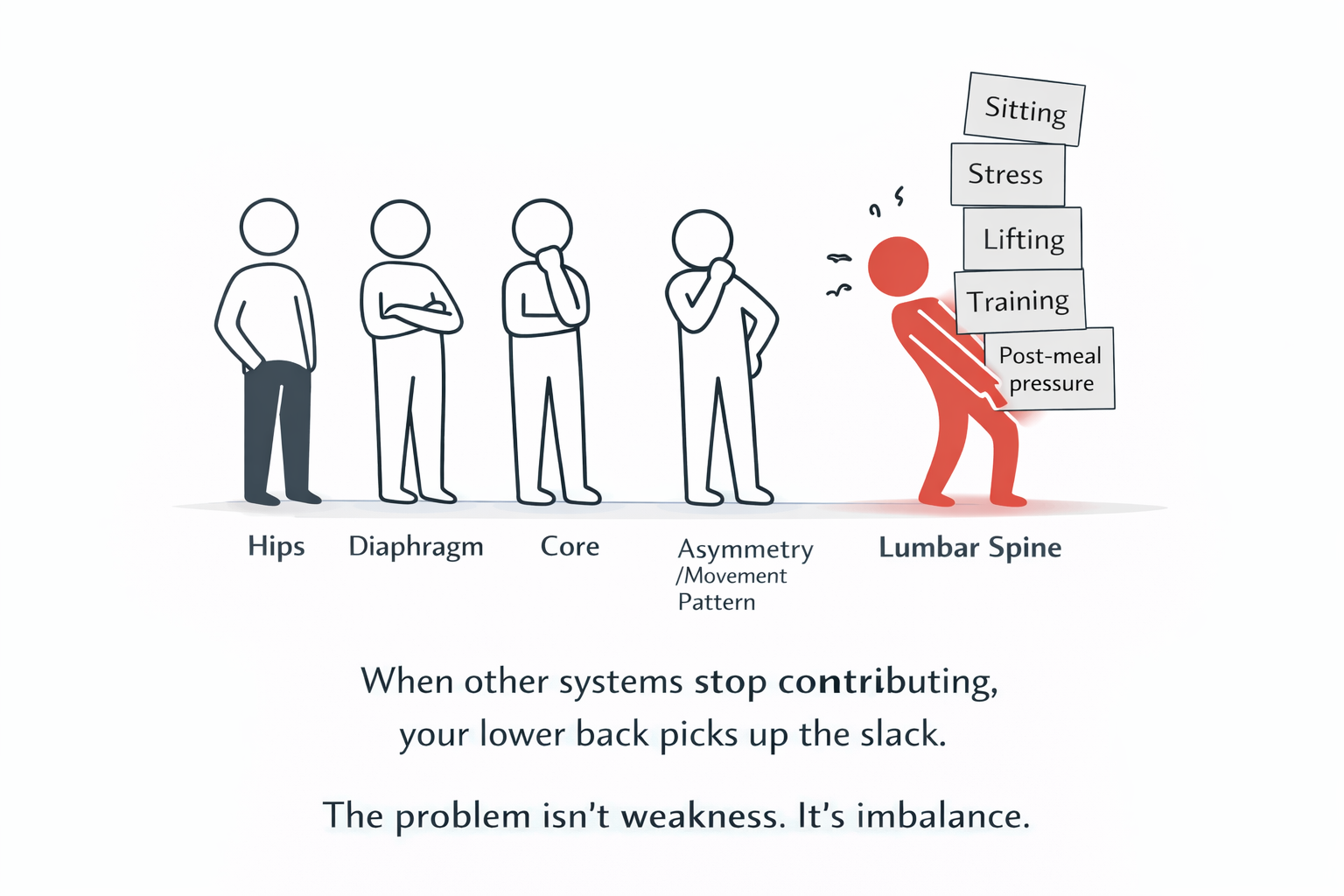
These patterns reveal compensation, not weakness. Your lower back is absorbing work that should be shared across multiple systems.
Five Areas That Dump Load onto Your Lower Back
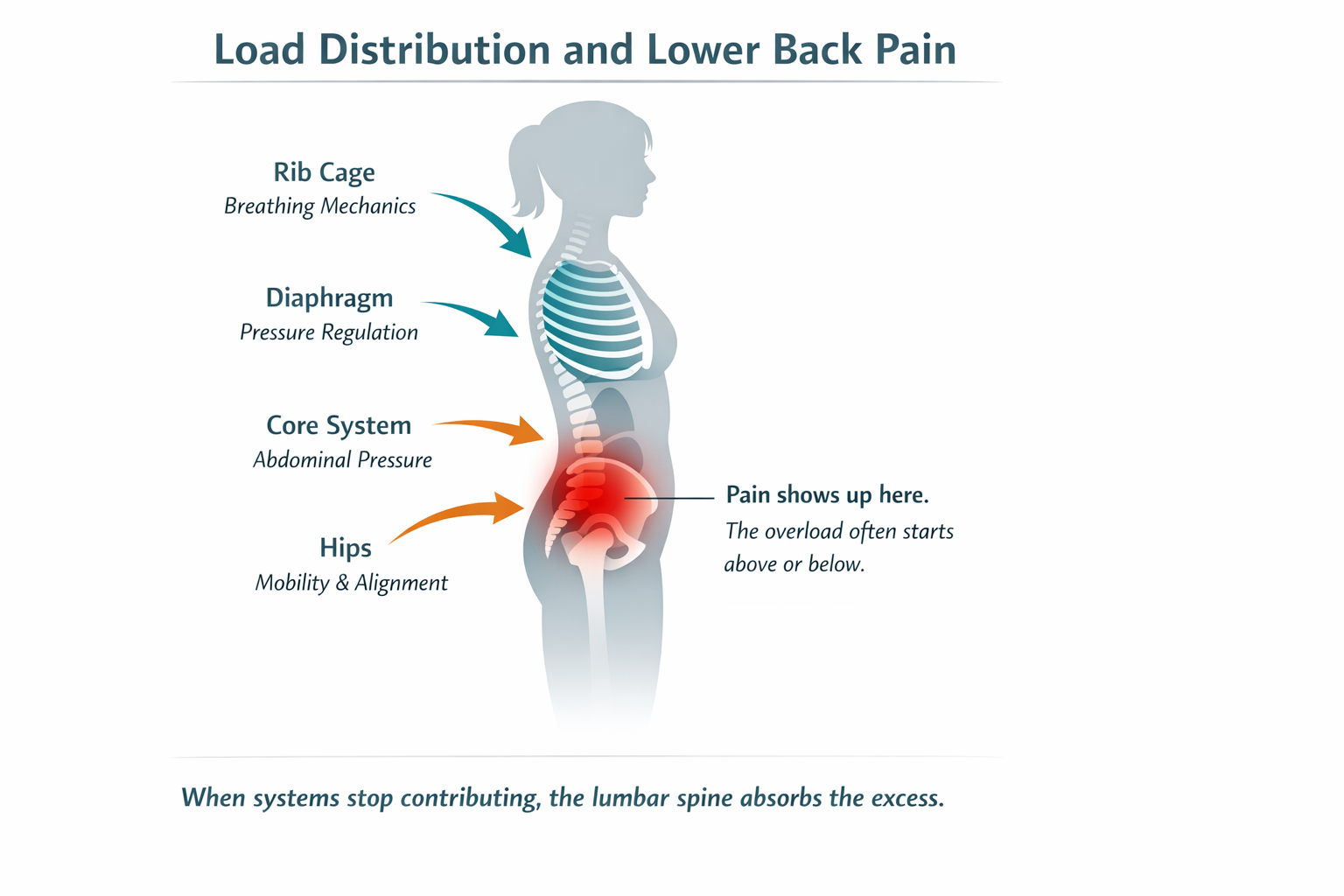
Your lumbar spine sits between your rib cage and pelvis. Its job is to transfer force efficiently—not absorb all of it.
When these systems fail to contribute, your back becomes the workhorse:
Limited hip mobility / poor pelvic articulation: When hip extension is limited, many people compensate by tipping the pelvis forward (anterior pelvic tilt) to create the appearance of more range. That strategy shifts demand upward and encourages the lumbar spine to contribute more motion than it should. Research notes that people commonly compensate for limited hip extension with increased anterior pelvic tilt, which can compound biomechanical stress.[1]
Breathing dysfunction: Poor diaphragm function means inadequate pressure management. Your back muscles become stabilizers when they should be movers. The diaphragm plays a crucial role in both respiration and spinal stability through intra-abdominal pressure regulation,[2] and altered breathing mechanics are commonly observed in chronic low back pain
Core timing problems: This isn't about weak abs. It's about coordination. Does your core activate at the right moment, or does it brace when you need mobility?
Digestive issues: GI symptoms like bloating and constipation often coexist with back pain. Research has found a strong association between GI symptoms and back pain, and proposed contributors include altered abdominal muscle function and reduced support for the spine.[3]
Movement asymmetries: Standing on one leg habitually, always rotating the same direction, carrying bags on one shoulder. Small habits compound into big problems
Your back isn't defective. It's compensating for areas that stopped pulling their weight.
Our Assessment Process: Finding the Pattern, Not Treating the Symptom
When clients come to our Toronto studio with chronic lower back pain, we don't treat the back first. We identify why stress keeps concentrating there.
Learn more about why we're different from typical personal training in Etobicoke.
Hip Function and Movement Quality
Restricted hips force excessive lumbar movement. We evaluate:
Hip flexion, extension, and rotation through full ranges
Whether you hinge properly or compensate through spinal flexion
How load distributes during squatting, hinging, and everyday activities
Breathing Mechanics and Pressure Regulation
Your diaphragm does more than move air. It regulates intra-abdominal pressure that supports spinal stability. Dysfunctional breathing means inadequate spinal support.
We assess:
Diaphragm excursion and rib cage mobility
Breathing patterns at rest versus under load
How stress affects your breathing strategy
Core Coordination and Timing
Chronic back pain rarely stems from weak abdominals. It's usually a timing problem:
Does your core activate before movement begins?
Do you brace when you need mobility, or stay loose when you need stability?
Is your strategy creating functional support or counterproductive stiffness?
Digestive Impact on Mechanics
Abdominal bloating and distension alter core function. Constant outward pressure forces compensatory back stabilization. Clients often report pain worsening post-meal—this is why.
Asymmetry Patterns
Habitual asymmetries compound over time: standing on one leg, unilateral rotation bias, one-sided carrying. We map these patterns to identify load concentration points.
Why Passive Treatment Keeps Failing
Massage, adjustments, stretching, and rest provide temporary relief. They calm irritation and reduce tension.
But they don't address why your back absorbs excessive load in the first place.
The predictable cycle:
Treatment reduces symptoms
Compensation pattern persists
You increase activity
Pain returns
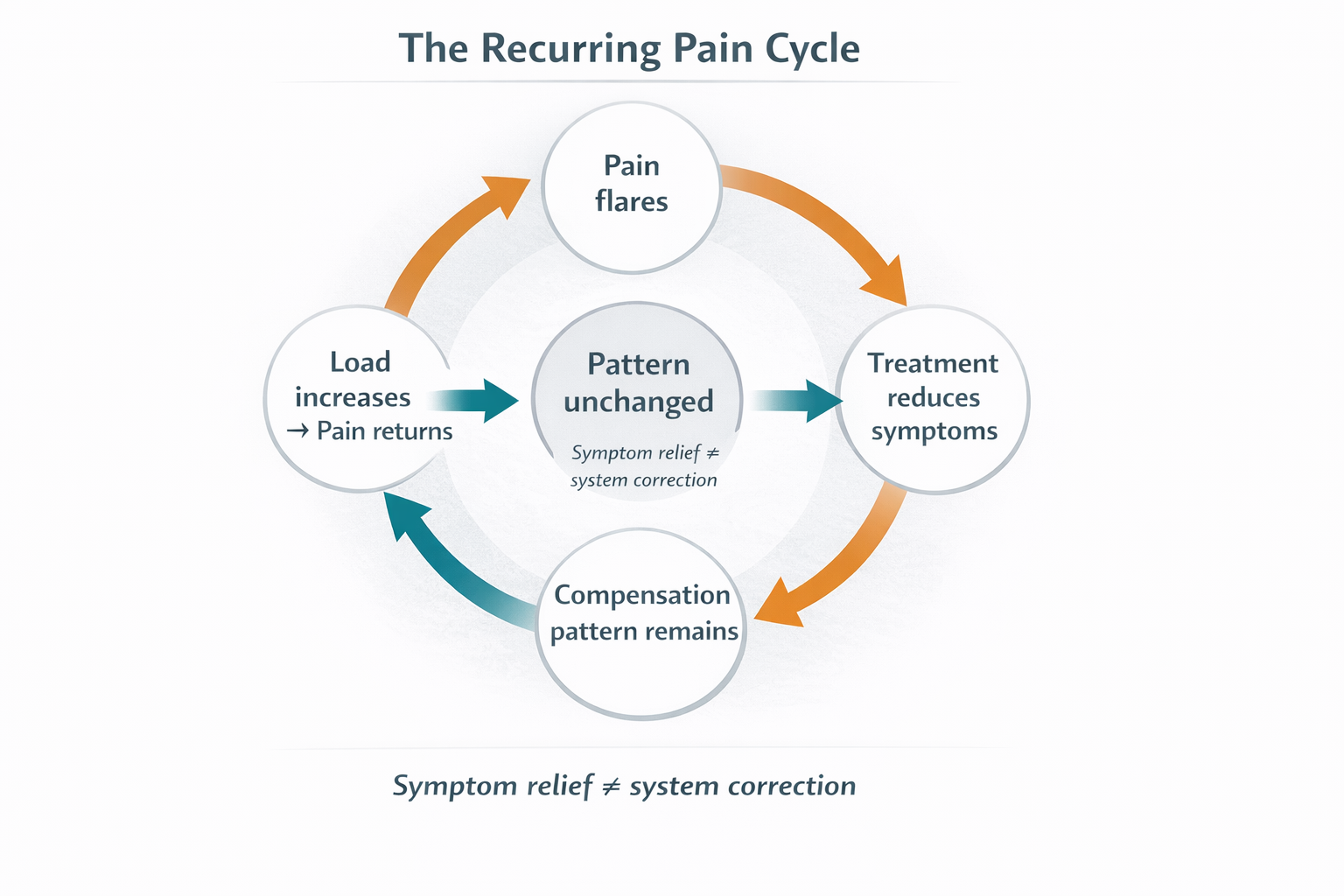
Breaking this requires changing load distribution and movement strategy—not just managing symptoms.
The 90-Minute Assessment That Identifies Your Pattern
We don't make assumptions. Our comprehensive movement assessment examines:
Rib cage and pelvic positioning
Breathing mechanics and pressure management
Hip mobility, control, and contribution
Load distribution during functional movements
This reveals your specific compensation pattern before we prescribe any exercise.
Learn about our assessment approach.
Corrective Exercise: Changing the System, Not Just Treating Symptoms
Corrective exercise for recurring back pain doesn't mean avoiding load or endless stretching.
It means:
Restoring hip mobility and contribution
Retraining breathing and pressure regulation
Building strength through improved movement patterns
Our corrective exercise approach targets the system, not just the symptom.
If Nothing Has Worked Long-Term
If treatment, rest, and caution haven't resolved your pain, you're not broken. The pattern just hasn't been identified yet.
Persistent lower back pain typically indicates:
Inadequate hip, breathing, or core contribution
Excessive load absorption at the lumbar spine
An unchanged compensation strategy
More back-focused treatment won't solve this. Understanding your system will.
Start With Assessment, Not Assumptions
If you're dealing with recurring lower back pain in Toronto and want clear answers—not guesses—start with assessment.
We'll evaluate hip function, breathing mechanics, core coordination, and movement patterns to determine what's driving your pain and whether our corrective exercise approach fits your situation.