

Why Your Knee Pain Isn't Really About Your Knee
Your knee hurt after that long run last week. You took a few days off, iced it, felt better. Then yesterday, going down the stairs to the subway, there it was again.
Different trigger. Same knee. Same frustration.
Here's the pattern most people miss: recurring knee pain isn't a knee problem. It's a load-sharing problem.[1]
Your knee isn't weak or damaged. It's absorbing stress that should be distributed across your entire leg. And until that changes, the pain will keep finding reasons to return.
Why the Knee Takes the Hit
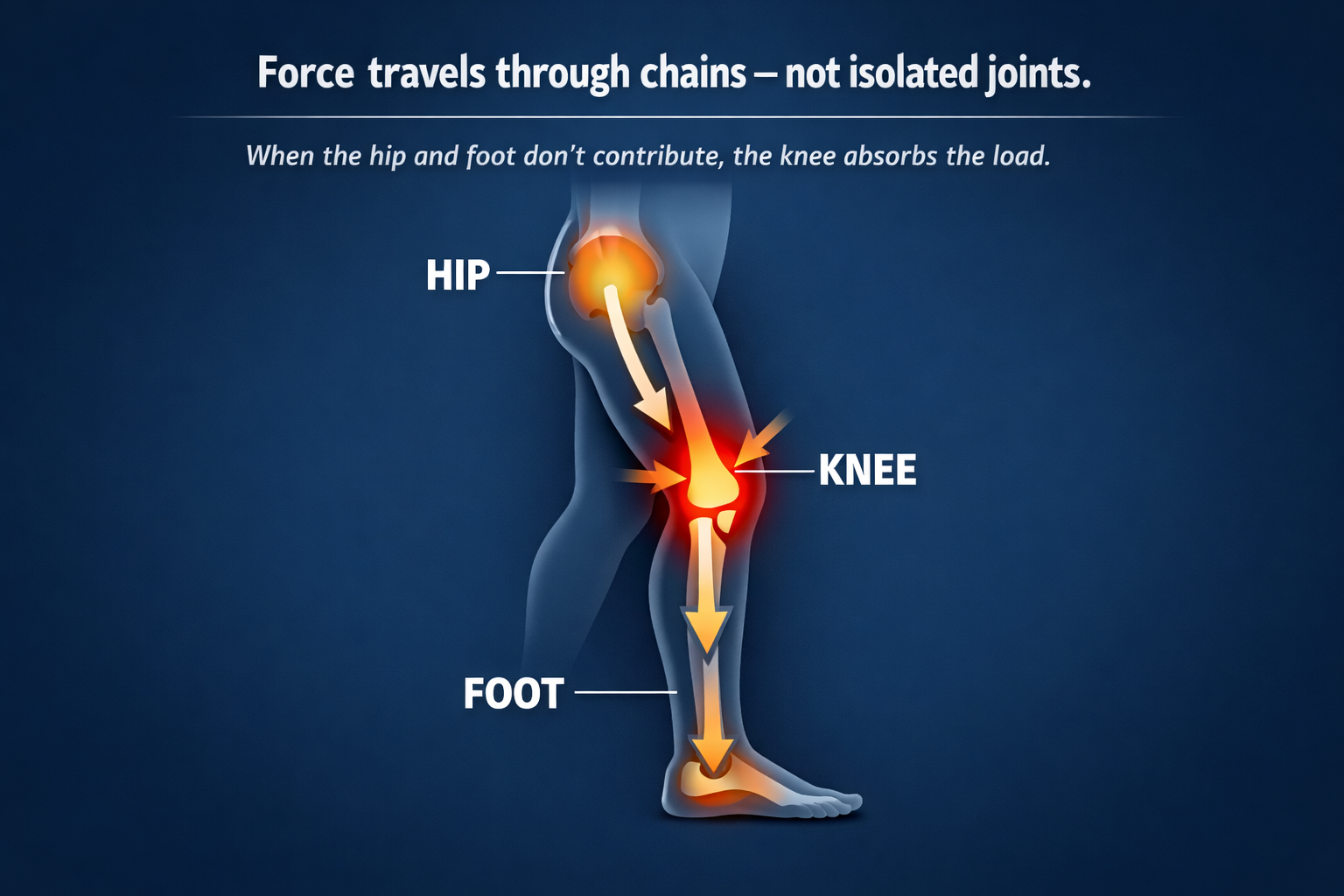
The knee is a pass-through joint. Its job is to transmit force between your hip and foot while moving through controlled ranges.
When the hip and foot do their jobs, the knee handles load well. When they don't, the knee becomes the default shock absorber for force it was never designed to manage alone.
Common complaints:
"Squatting and stairs hurt"
"Running feels fine until it suddenly doesn't"
"My knee improved with physio, then the pain came back"
The pain is real. But it's usually the result of poor load distribution—not isolated knee damage.
Four Compensation Patterns That Overload Your Knee
Force moves through chains, not isolated joints. When one link fails to contribute, the knee compensates:
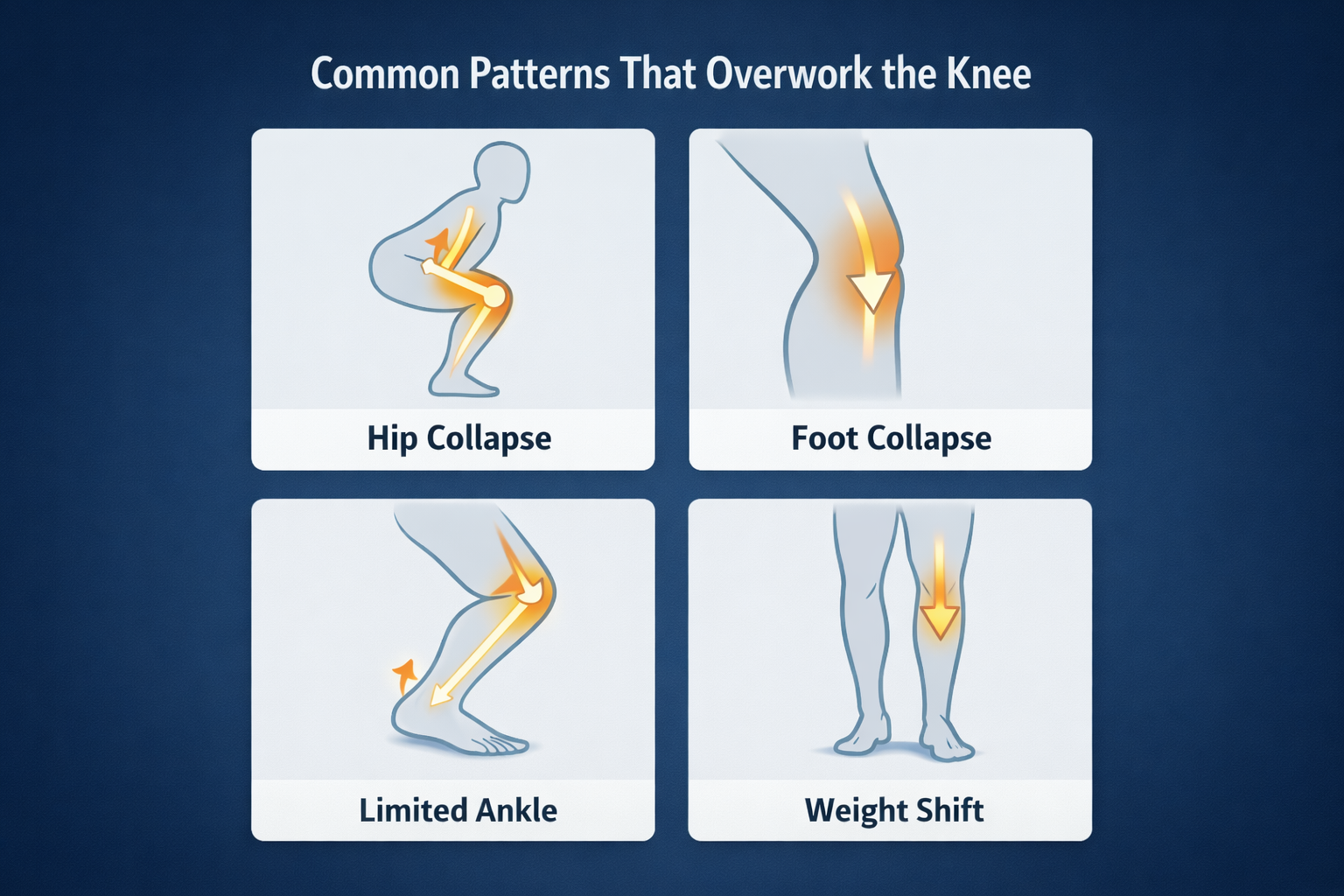
Poor hip control: Limited hip stability causes the knee to collapse inward or rotate excessively under load
Foot dysfunction: If your foot collapses or stiffens inappropriately, force travels inefficiently up the leg and concentrates at the knee
Restricted ankle mobility: When your ankle can't move through necessary ranges, your knee compensates by moving more—or differently—than it should
Asymmetrical loading: Habitual weight shifts, favoring one leg, or avoiding depth on one side forces one knee to absorb disproportionate stress
Your knee isn't weak. It's overworked because other areas stopped contributing.
This pattern appears across multiple joints. Read more about why pain location misleads.
What Pain Location Around the Knee Actually Reveals
While pain location doesn't identify root causes, the knee offers clearer clues than some joints. With fewer muscular attachments, it has less capacity to hide compensation.
Where you feel pain hints at how your body is compensating:
Pain above or below the kneecap: Often indicates quadriceps dominance or compromised hip control
Lateral (outside) knee pain: Frequently reflects tension patterns involving the lateral hip and IT band
Medial (inside) knee pain: Commonly associated with altered load distribution through the inner chain
These patterns don't diagnose injury. They reveal which systems are overworking and which are under-contributing.
The knee reports what it's handling—not what caused the problem. Pain location is an investigation starting point, not a conclusion.
Our Toronto Knee Pain Assessment: Tracking Force Through the Entire Leg
When clients present with chronic knee pain, we don't isolate the knee. We assess how force distributes through your entire lower limb.
Hip Stability and Control
Your hip controls femur position as load travels through your leg. Limited hip control causes the knee to:
Collapse inward during squats or stairs
Rotate excessively while walking or running
Feel unstable under load
This isn't always weakness. Often it's a coordination and timing problem.[2]
Foot Mechanics and Arch Function
Your foot is the foundation. When it collapses, stiffens inappropriately, or fails to adapt to terrain, your knee manages force it shouldn't.
Common presentations:
Pain during prolonged standing or walking
Worsening discomfort on uneven surfaces
Symptoms that change dramatically with different footwear
Ankle Mobility and Control
Restricted ankle range of motion alters force transmission up the leg. When your ankle can't move adequately, your knee compensates by moving more—or differently.[3]
This concentrates stress on:
The anterior (front) knee
Medial or lateral joint lines
Surrounding soft tissue
Load Distribution Patterns
How you stand, walk, squat, and step matters. Small asymmetries compound:
Habitually favoring one leg
Unconscious weight shifts
Avoiding depth or range unilaterally
Your knee becomes the bottleneck where these patterns concentrate.
Movement Strategy Under Load
Two people doing identical exercises can load their knees completely differently. We evaluate:
Where movement initiates
How force absorbs through the chain
Whether your knee guides motion or reacts to compensations elsewhere
These details matter more than raw strength measurements.
Why Knee-Focused Treatment Fails Long-Term
Rest, ice, bracing, and isolated strengthening provide temporary relief. They calm irritation and improve tolerance.
But they don't address why your knee absorbs excessive force.
The predictable result:
Temporary improvement
Gradual symptom return
Frustration when you resume full activity
This is the most common pattern we see in Toronto with chronic knee pain.
How Assessment Reveals the Real Driver
We start with assessment, not assumptions. Rather than treating the knee, we evaluate:
Hip control and coordination
Foot and ankle mechanics
Weight distribution patterns
Movement quality under controlled load
This identifies where compensation occurs and why—before we add intensity, volume, or complexity.
Learn about our assessment process.
Corrective Exercise: Teaching Better Load Distribution
Corrective exercise for knee pain doesn't mean avoiding load or protecting the joint indefinitely.
It means:
Teaching efficient force distribution
Restoring hip, foot, and ankle contribution
Progressively loading improved patterns—not reinforcing compensation
This is why our approach differs from traditional knee rehab programs.
Explore our training methodology.
If Treatment Hasn't Resolved Your Knee Pain
Persistent knee pain—despite treatment, rest, or modification—tells you something important:
Your knee is compensating for inadequate contribution elsewhere
Force isn't distributing properly through your leg
The underlying pattern hasn't been identified
This doesn't mean your knee is damaged. It means the system needs assessment.
Start With Assessment, Not Guesswork
Recurring knee pain in Toronto deserves clear answers, not generic advice.
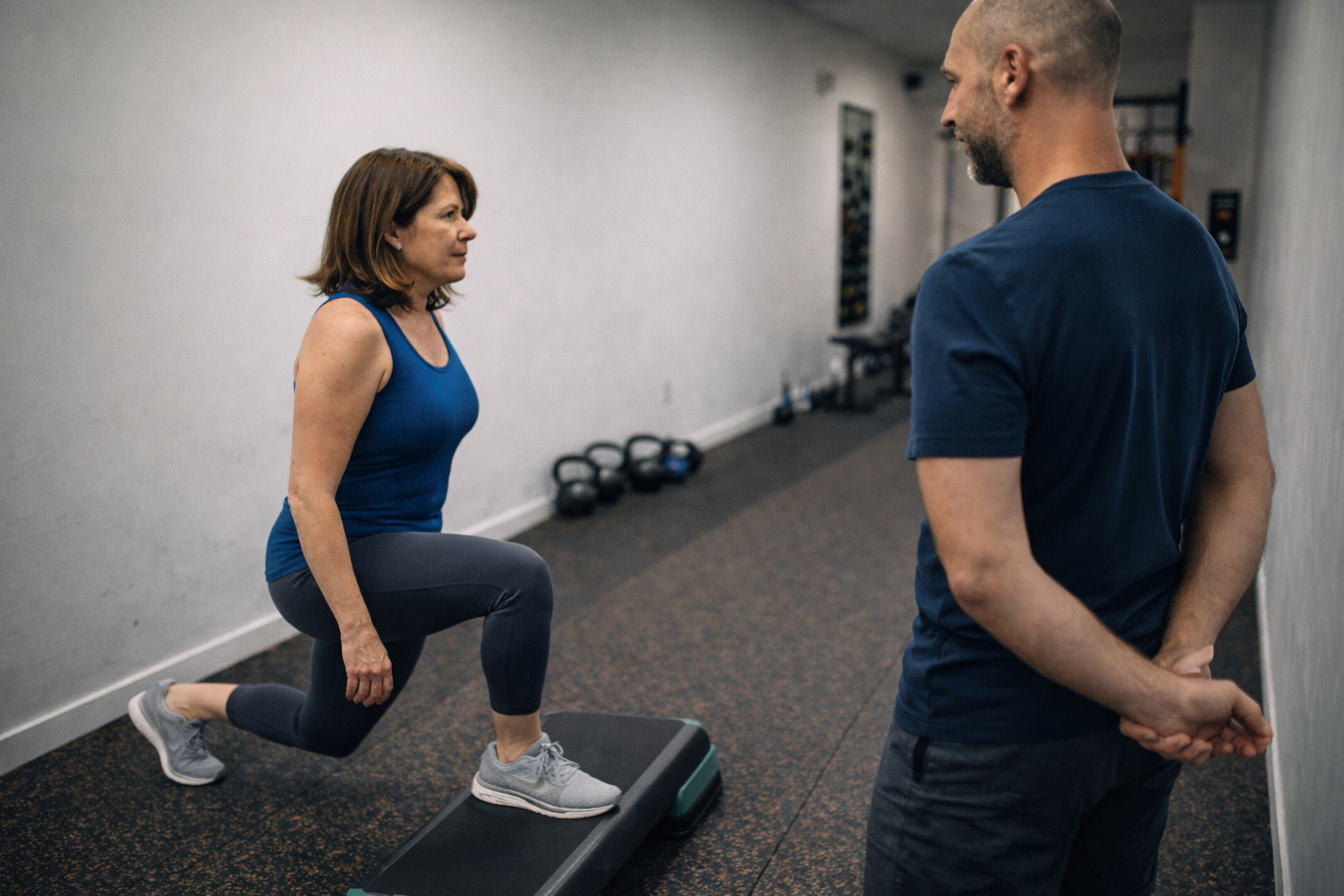
We'll analyze how your hip, foot, ankle, and movement patterns interact to identify what's driving your knee pain—and determine if our corrective exercise approach fits.