

Why Your Neck Pain Isn't Just a Neck Problem

By mid-afternoon, that familiar tension creeps up the back of your neck. You roll your shoulders, tilt your head side to side. It helps for maybe ten minutes.
You've tried massage, stretching, ergonomic adjustments. The tightness eases temporarily, then returns—especially during demanding work weeks.
Here's the disconnect: your neck isn't the problem. It's the victim of inadequate support from below.
Your neck's job is to coordinate head movement, not stabilize your entire upper body. When your rib cage, breathing, and trunk fail to provide support, your neck compensates by doing work it was never designed for.
Why Your Neck Stays Tight
Chronic neck pain doesn't exist in isolation. Your neck sits at the intersection of your head, rib cage, and spine. Its role is coordination—not primary stabilization.
When postural support and breathing responsibilities shift upward, your neck becomes overloaded.
Recognize these?
"My neck feels tight constantly"
"Stretching helps briefly, then the tension returns"
"Stressful or busy weeks make it worse"
The pain is real. But it's the result of your neck compensating for systems below that stopped contributing.
Four Support Failures That Overload Your Neck
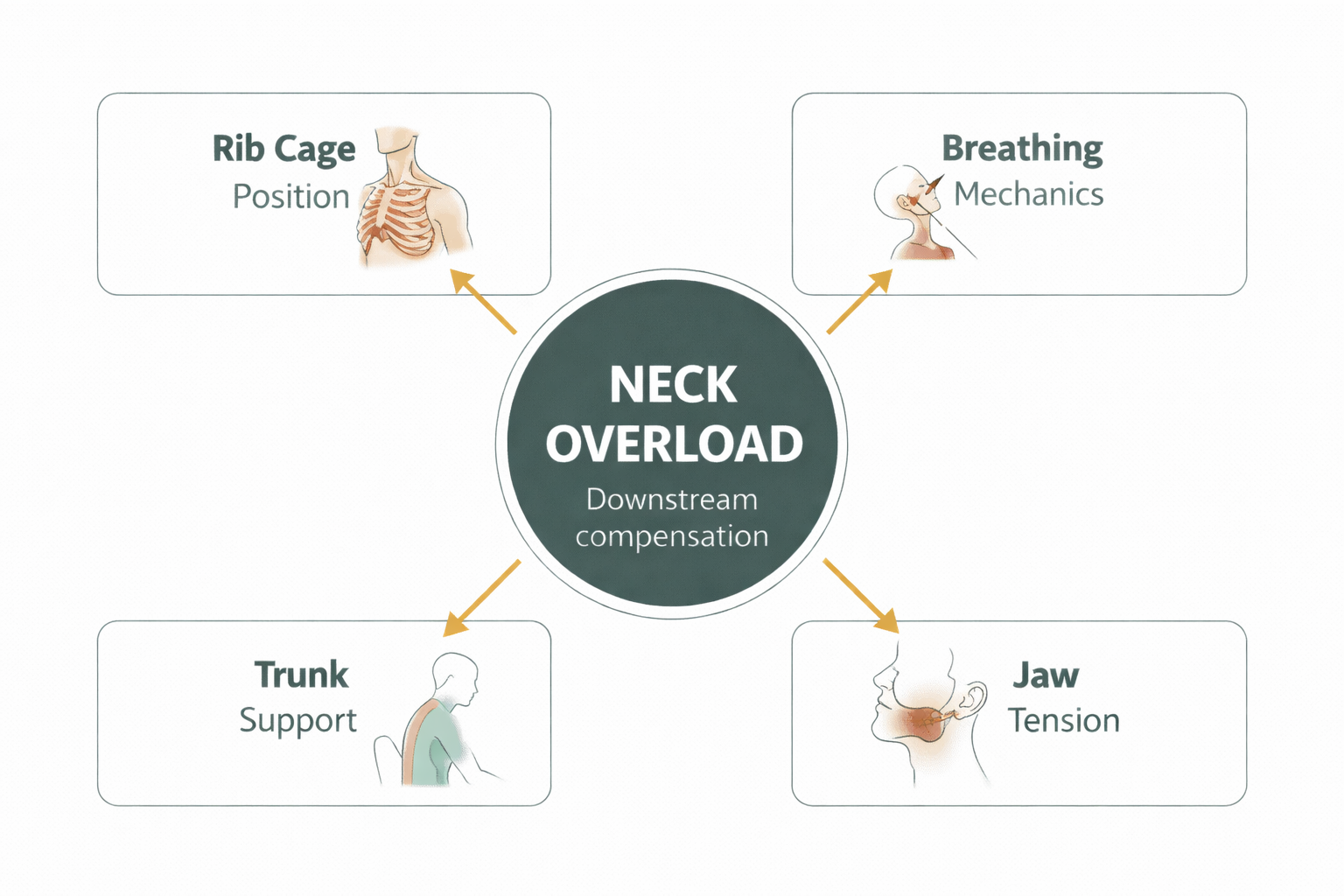
Your neck can't carry postural load alone. Its ability to stay relaxed and mobile depends on rib cage position, breathing mechanics, trunk support, and jaw function.
When these systems fail, your neck accumulates tension:
Rib cage positioning dysfunction: A chronically lifted or collapsed rib cage forces your neck to work harder maintaining head balance. This creates constant low-grade tension, fatigue during desk work, and difficulty relaxing even at rest.
Breathing pattern problems: Shallow, chest-dominant breathing recruits neck and upper chest muscles with every breath. Over time, this creates persistent tightness, reduced mobility, and heightened stress sensitivity. This is the most overlooked contributor to chronic neck pain.[1]
Inadequate trunk support: When your trunk fails to provide postural support, your neck becomes a stabilizer instead of a coordinator. This intensifies during prolonged desk work, device use, and fatigue-based posture collapse.
Jaw and upper cervical tension: Clenching, grinding, or habitual jaw tension increases upper neck tone, limits cervical mobility, and reinforces protective patterns.[3] This connection is frequently missed in local neck treatment.
Your neck isn't weak. It's overworked.
Why Neck Pain Location Confuses
Neck pain feels specific: base of skull, sides of neck, into shoulders, radiating up to the head, or down between shoulder blades.
But the neck's dense muscular, neural, and connective tissue overlap makes location misleading. Where you feel pain reflects:
How your head is being supported
Where tension generates
How breathing and posture interact
Location provides investigation clues, not diagnostic answers.
Our Toronto Neck Assessment: Evaluating Support Systems
When clients present with chronic neck pain, we don't treat the neck. We assess how your head and neck are being supported by systems below.
Rib Cage Position
Your rib cage plays a major role in head and neck posture. Excessive lifting or collapsing forces your neck to work harder maintaining head balance, causing:
Constant baseline neck tension
Fatigue during prolonged sitting or computer work
Inability to relax your neck even at rest
Breathing Mechanics
Breathing directly influences neck tone. Shallow or chest-dominant patterns recruit neck and upper chest muscles with every breath, creating:
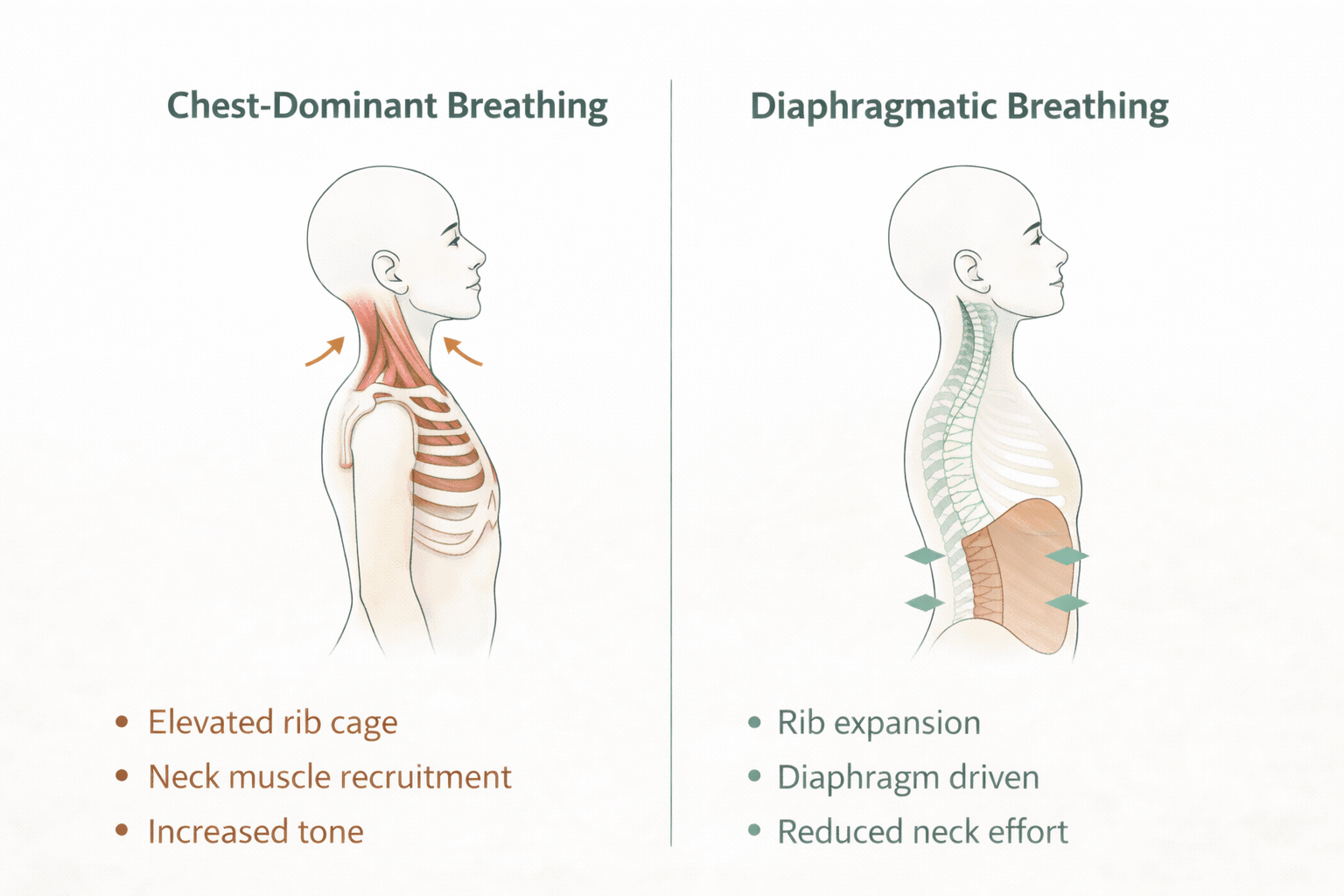
Persistent tightness
Reduced cervical mobility
Heightened stress and workload sensitivity
This is the most commonly overlooked chronic neck pain driver.
Postural Support Strategy
Posture isn't about standing straight. It's about support distribution.
When your trunk fails to provide adequate support, your neck assumes a stabilizing role—particularly during:
Extended desk work
Phone or laptop use
Fatigue-driven posture collapse
Your neck becomes a postural anchor instead of a movement coordinator.
Jaw and Upper Cervical Function
Your jaw and upper cervical spine directly influence neck tone. Clenching, grinding, or jaw tension:[2][3]
Increases upper neck tone
Limits cervical mobility
Reinforces protective patterns
This connection is routinely missed in local neck treatment.
Stress and Load Response
Neck pain fluctuates with workload, stress, and fatigue. We evaluate:
Neck response under cognitive and physical load
Tension progression throughout the day
Recovery pattern influence on symptoms
These factors explain apparent unpredictability.
Why Neck-Focused Treatment Fails Long-Term
Massage, stretching, adjustments, and isolated neck exercises provide temporary relief. They reduce tone, calm irritation, and improve short-term comfort.
But they don't address why your neck is overloaded.
The predictable pattern:
Temporary relief
Gradual symptom return
Increasing treatment dependence
This is the most common chronic neck pain pattern in Toronto.
How Assessment Reveals the Real Problem
We assess the support system first—not just the pain site. Rather than assuming neck dysfunction, we evaluate:
Rib cage and trunk positioning
Breathing mechanics
Postural support strategies
Neck movement under controlled load
This identifies where compensation occurs and why—before we add exercise, volume, or intensity.
Learn about our assessment approach.
Corrective Exercise: Restoring Support Below
Corrective exercise for neck pain isn't about endless stretching or movement avoidance.
It's about:
Restoring trunk and rib cage support
Reducing excessive neck tone
Teaching free neck movement without stabilization duties
This is why our approach differs from traditional neck rehab programs.
Explore our training methodology.
If Treatment Hasn't Resolved Your Neck Pain
Persistent neck pain despite treatment, rest, or posture changes reveals:
Neck compensation for inadequate support elsewhere
Breathing and posture patterns feeding excessive tone
Unidentified underlying patterns
Your neck isn't damaged. The support system needs assessment.
Start With Support System Assessment
Recurring neck pain in Toronto deserves clear answers, not generic advice.
We'll evaluate rib cage position, breathing mechanics, postural support strategies, and movement patterns to determine what's driving your neck pain—and whether our corrective approach fits.
References
Correlation between pulmonary functions and respiratory muscle activity in patients with forward head posture (2018). [1]
Tomita Y, et al. Effects of sitting posture and jaw clenching on neck and trunk muscle activities during typing. Journal of Oral Rehabilitation (2021). [2]
Ehrlich R, et al. The Effect of Jaw Clenching on the Electromyographic Activity of Neck and Trunk Muscles. Journal of Orofacial Pain (1999). [3]
Correlation between Temporomandibular Disorders (TMD) and Posture Evaluated through the Diagnostic Criteria for Temporomandibular Disorders (DC/TMD): A Systematic Review with Meta-Analysis (2023). [4]